Quick Summary: Patchy lawns in New Orleans fail for one of six reasons: fungal disease, chinch bug infestation, drought stress, dense shade, soil compaction, or a grass variety that is wrong for the site conditions. Treating a patch without identifying the cause first leads to repeated failure. The standard extension threshold for repair versus full renovation is 50 percent: if less than half the lawn is healthy grass, full replacement is more cost-effective than patching. St. Augustine, the dominant grass in the New Orleans metro, cannot be restarted from seed and must be sodded. Spring, from April through mid-June, is the primary resodding window.
Last Updated: May 2026
A brown, patchy lawn in New Orleans is almost never caused by just one thing. The humid subtropical climate, below-sea-level lots with heavy clay, dense urban tree canopy, and year-round warm-season grass management create a situation where multiple stressors often overlap. A chinch bug infestation in August opens bare soil to large patch infection in October, which a homeowner fertilizes over in November trying to speed recovery, making the disease worse. Breaking that cycle starts with identifying the actual cause before spending money on treatment.
Big Easy Sod performs lawn assessments across the New Orleans metro. You can start the process at bigeasysod.com to schedule an evaluation before committing to any repair approach.
What causes bare patches in a New Orleans lawn?
Six causes account for the vast majority of patchy lawns in the New Orleans area. Most can be identified with a visual inspection and one or two simple tests.
Large patch disease produces circular or ring-shaped patches that appear in fall and spring, return to the same spots annually, and leave a soft, rotting smell at the base of pulled grass blades. It is the most common lawn disease in Louisiana, per LSU AgCenter.
Chinch bugs are tiny black insects with white wings that drain sap from St. Augustine grass. Their damage always begins near hot concrete surfaces such as driveways, sidewalks, and curbs, then spreads outward. Peaks in June through August during the hottest stretches.
Drought stress creates uniform thinning across exposed, sunny areas rather than defined patches. The lawn greens up within 48 hours of adequate irrigation. In NOLA’s clay soil, true drought stress is less common than disease, but dry spells in June and October do affect lawns without irrigation coverage.
Dense shade eliminates grass over time in areas under mature live oaks, southern magnolias, and other canopy trees. LSU AgCenter states plainly that no fertilizer or watering routine can replace sunlight. Areas receiving fewer than 4 hours of direct sun per day will not sustain any warm-season grass long-term.
Soil compaction from clay and heavy foot traffic restricts root penetration and water infiltration. The rod test: if a screwdriver will not press 6 inches into moist soil, compaction is likely limiting growth.
Take-all root rot destroys the root system before surface symptoms appear. Roots pulled from affected soil are short, dark brown, and brittle rather than white and abundant. Irregular, diffuse yellowing without a defined circular pattern is the above-ground clue.
How do you identify the cause before treating?
The sequence matters. Running through these steps in order prevents misdiagnosis and wasted treatment cost.
First, count sunlight hours in the affected area. If the patches are under a tree canopy or on the north side of a structure and receive fewer than 4 hours of direct sun, shade is the primary problem. No disease treatment or repair sod will hold long-term until the light issue is addressed.
Second, check the location and timing of the damage. Large patch produces circular patches appearing in October through November or February through April. Chinch bug damage starts at the edges of hot concrete in June through August and expands outward in irregular shapes. Drought stress appears uniformly in exposed areas during dry periods and responds to irrigation within 48 hours.
Third, do the base-of-blade test for fungal disease. Pull a grass blade from the edge of the affected area. If the base pulls away from the stem easily and shows dark brown rot with a bad smell, large patch is the likely cause. Clean, unrotted base tissue points away from Rhizoctonia.
Fourth, do the soap flush test for chinch bugs. Pour a solution of 2 tablespoons of dish soap in one gallon of water over one square foot of grass at the edge of the dead patch. Wait 10 minutes. Chinch bugs float to the surface if present. A confirmed pest infestation is treated differently from a fungal disease and requires an appropriate insecticide, not a fungicide.
Fifth, dig a plug from the dead edge of the patch and examine the roots. For large patch and drought stress, roots will be intact. For take-all root rot, roots are short, dark, brittle, and sparse. For grub damage (a less common NOLA problem), roots are severed near the surface and the sod layer lifts off like loose carpet.
When does a patchy lawn need full replacement instead of spot repair?
The extension rule from Clemson HGIC and UF/IFAS is consistent: if less than 50 percent of the lawn is healthy grass, full renovation is more cost-effective than patching. Spot repairs on a lawn that is more dead than alive rarely hold because the underlying conditions that killed the original grass are still present.
Full replacement is the right call when multiple problems overlap simultaneously, when perennial weeds have taken over more than 40 percent of the area, when the wrong grass species was planted for the conditions, or when a drainage or grading problem makes the entire area prone to standing water. In those cases, the right approach is a complete renovation: treat the soil, fix the drainage, and install the correct grass variety for the site.
The sod installation specialists at Big Easy Sod assess whether spot repair or full renovation makes sense based on the percentage of healthy grass, the underlying cause, and the site conditions.
How do you prepare bare soil for resodding in New Orleans?
Laying new sod over an untreated problem guarantees the same result as before. The preparation work takes almost as long as the installation itself, but it is what determines whether the new grass survives.
Remove all dead grass and thatch from the area. If disease killed the patch, bag and discard the dead material rather than composting it. Treat the underlying cause: apply the appropriate fungicide for disease, treat for insects if confirmed, correct drainage issues before laying sod over wet soil.
Do the rod test: push a screwdriver into moist soil. If it will not penetrate 6 inches without significant resistance, the soil needs core aeration or tilling before amendment. For areas with NOLA clay and compaction, till to 6 to 8 inches and incorporate organic matter at 3 to 6 cubic yards per 1,000 square feet.
Grade the patch to match the surrounding lawn, sloping slightly away from the house at 1 to 2 percent. Avoid leaving low spots that collect standing water. This step matters especially for below-sea-level NOLA lots where poor drainage is often the original cause of the patch. Water immediately after laying the new sod and keep it moist for 2 to 3 weeks as the roots establish.
What is the best time of year to repair patches in a New Orleans lawn?
Spring is the primary window, from April through mid-June. Warm-season grasses need warm soil and at least 3 to 4 months of growing conditions before winter dormancy to establish properly. Sod laid in spring has a full growing season ahead of it.
Late summer installs from late July through mid-August can succeed in New Orleans because there are still 3 or more months of warm weather ahead, but the combination of peak heat and transplant stress means strict watering discipline is required. Avoid installing sod in peak summer heat in June and early July unless the homeowner can commit to the watering schedule detailed in the Big Easy Sod maintenance guide.
Do not resod in fall or winter. Sod laid in October and November will not root before dormancy. The same applies after late-season hurricanes: wait until spring to evaluate whether damaged grass will recover before replacing it. Warm-season grasses look completely dead all winter and may come back from the crown.
What grass works in shaded New Orleans yards where St. Augustine fails?
New Orleans is a heavily canopied city. Live oaks, magnolias, and old-growth shade trees are part of what makes neighborhoods like Uptown, the Garden District, and Bayou St. John so visually distinctive. They also create conditions where no warm-season grass survives permanently in the deepest shade zones.
St. Augustine is the most shade-tolerant of the warm-season grasses used in New Orleans, needing 4 to 6 hours of direct sun. Shade-tolerant varieties including Seville, Captiva, and Mercedes perform better under partial canopy than standard varieties. Fine-textured Zoysia varieties such as Emerald and Zeon handle moderate shade as well.
Under dense canopy where no grass will hold, LSU AgCenter’s own research recommends mondograss (Ophiopogon japonicus) as the top alternative. Mondograss thrives in deep shade, requires no mowing, multiplies steadily, and outcompetes weeds once established. Liriope muscari is a second option with broader leaves and visible flowers in late summer.
Frequently Asked Questions
Can you reseed a bare patch in a New Orleans lawn?
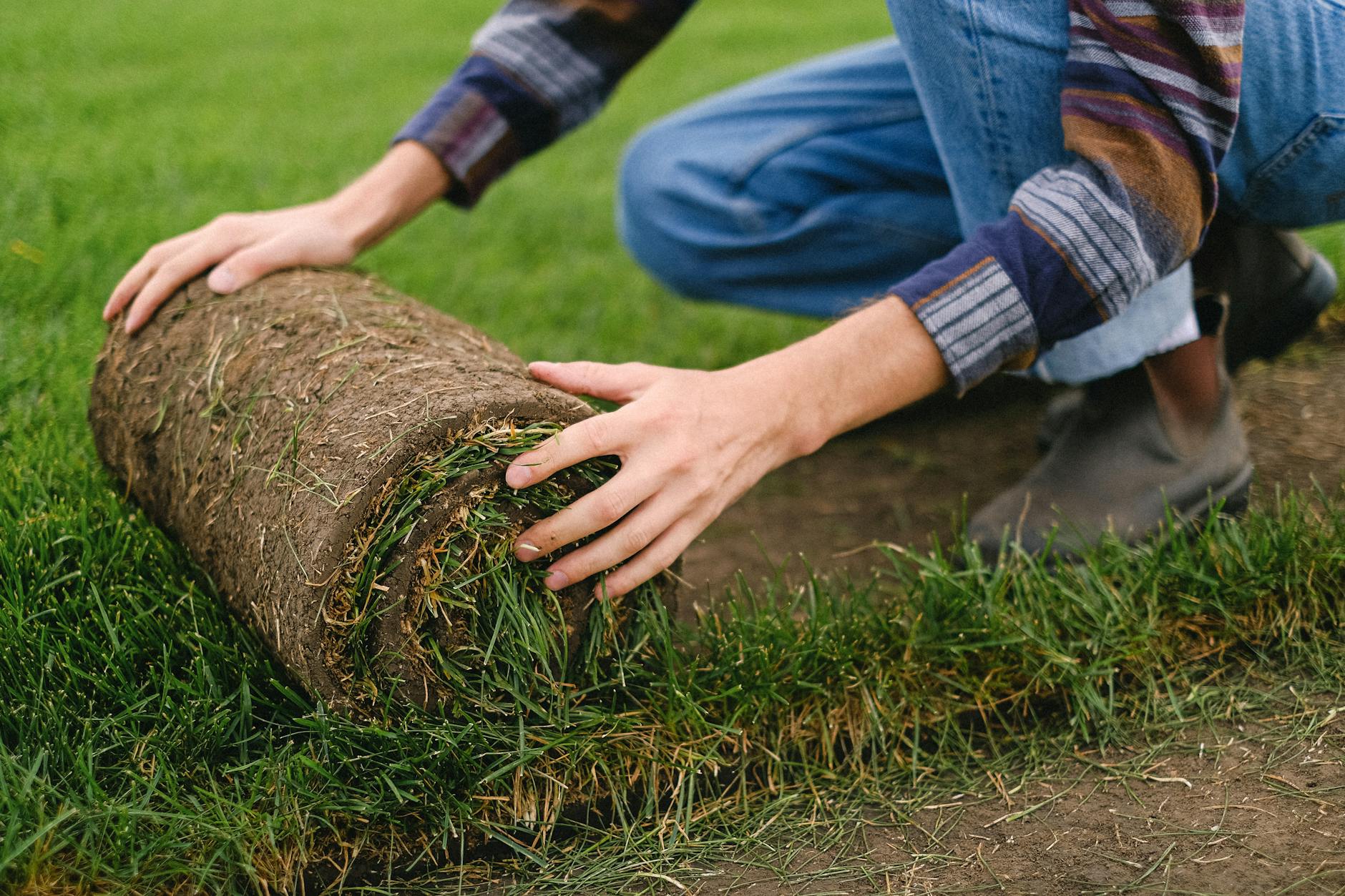
Not with St. Augustine, which is the dominant grass across the New Orleans metro. St. Augustine cannot be established from seed and must be repaired with sod pieces or plugs. Bermuda can be seeded in bare patches, but sod or plugs establish faster and more reliably.
When is the best time to resod a bare spot in New Orleans?
Spring, from April through mid-June, gives new sod the full growing season to establish before winter dormancy. Late summer installs from late July through mid-August can also succeed with disciplined watering. Avoid fall and winter installations; sod will not root before the grass goes dormant in December.
What kills grass in patches in New Orleans?
Large patch fungal disease causes the majority of circular, recurring brown patches. Chinch bugs cause irregular patches that start near concrete in summer. Shade kills grass gradually under dense tree canopy. Take-all root rot destroys roots underground, causing diffuse yellowing. Soil compaction and the wrong grass variety for the site are also common factors.
How do I treat a bare spot in my lawn before resodding?
Remove all dead material and bag it. Treat the underlying cause: apply fungicide for disease, use appropriate insecticide for pests, improve drainage if pooling was a factor. Test for compaction with the screwdriver rod test and till if soil is hard. Grade the area to eliminate low spots, then lay sod and water immediately.
Will my New Orleans lawn come back after hurricane damage?
Often yes. Warm-season grasses look completely dead all winter and after stress events, but the crown may still be viable. After a late-season hurricane, do not resod in fall. Wait until April to May to see whether recovery occurs from the crown. Remove debris immediately after any storm event; every day debris sits on the lawn extends damage.
What grass can I plant in heavy shade in New Orleans?
For areas with fewer than 4 hours of direct sun, no warm-season grass will hold permanently. LSU AgCenter’s own research at the Burden Research Center recommends mondograss (Ophiopogon japonicus) as the top deep-shade alternative. It requires no mowing, thrives in dense shade, and spreads to fill an area within a few seasons.
How much does it cost to resod a bare patch in New Orleans?
National cost data from Fixr shows St. Augustine sod at $0.85 to $1.75 per square foot fully installed, with small project minimums typically starting around $1,200 to $2,000 for 200 to 500 square feet. DIY patch repairs using a partial pallet run $90 to $195 in materials plus soil prep and labor time. The risk in DIY patching is that failing to address the underlying cause leads to the same result within one to two seasons.